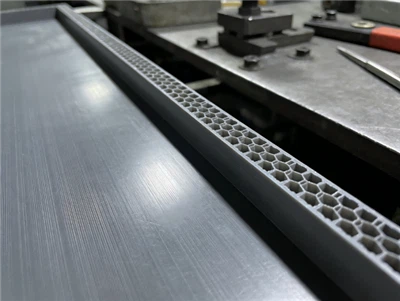
Honeycomb sandwich panels are traditionally designed as permanent structural elements. Their geometry, bonding strategy, and load paths assume that the panel will be assembled once, loaded in a predictable manner, and remain largely undisturbed throughout its service life. CKD and knock-down structures fundamentally violate these assumptions.
In CKD applications, panels are transported, handled, assembled, disassembled, and sometimes reassembled multiple times. Loads are not only operational but also logistical. Edge conditions change, fastener locations are reused, and tolerances accumulate. Under these conditions, panels that perform well in fixed installations often exhibit unexpected damage, looseness, or progressive degradation.
Designing honeycomb panels for CKD structures therefore requires a different mindset. The core challenge is not achieving maximum stiffness or minimum weight, but .
Load Cases Unique to CKD and Knock-Down Applications
In conventional sandwich panel design, load cases are well defined: bending under service load, shear transfer through the core, and localized compression at supports. CKD structures introduce additional load cases that are rarely addressed explicitly.
Panels experience concentrated loads during lifting, torsion during alignment, and impact loads during packaging and transport. Fasteners are repeatedly tightened and loosened, introducing cyclic bearing and pull-through stresses. Edge-supported panels may temporarily become point-supported during assembly.
These transient load cases often govern failure, even if they occur only briefly. A panel that survives years of static service may fail after a few poorly controlled assembly cycles.
Honeycomb cores excel in distributing uniform loads but are vulnerable to localized stress. In CKD structures, load paths are rarely uniform. Fasteners, brackets, and frames introduce concentrated forces that interact poorly with open-cell core geometries.
Repeated assembly amplifies this effect. Micro-crushing of cell walls accumulates, reducing local stiffness. Once stiffness drops, load redistributes to adjacent areas, accelerating damage progression. This process is often invisible until significant structural degradation has occurred.
Unlike foam or solid cores, honeycomb damage is discrete and progressive. Individual cell walls fail, but the panel remains intact-until it does not. This delayed failure mode makes honeycomb panels deceptively fragile in CKD environments.
Edges are the most critical and most underestimated aspect of CKD panel design. In knock-down structures, edges are not merely boundaries; they are interfaces. They carry fasteners, transfer loads into frames, and absorb assembly-induced misalignment.
Unreinforced honeycomb edges are structurally incomplete. Cell walls terminate abruptly, leaving adhesive and thin face sheets to carry loads they were never designed to sustain repeatedly. Under cyclic assembly, edge regions experience peel, bearing, and shear simultaneously.
Field failures consistently show that CKD-related damage initiates at edges long before face sheets or core interiors show signs of distress.
CKD structures almost always rely on mechanical fasteners. These fasteners are reused, retightened, and occasionally over-torqued. In honeycomb panels, fastener performance depends entirely on how loads are transferred into the core.
Without proper inserts or edge reinforcement, fastener loads are carried by thin face sheets and localized adhesive regions. Repeated loading causes hole elongation, adhesive cracking, and eventual pull-through. Importantly, failure does not require overload-fatigue and micro-movement are sufficient.
Once bearing damage begins, stiffness loss accelerates. Fasteners loosen more easily, increasing movement and further degrading the joint. This feedback loop is a defining risk in CKD panel systems.
Tolerance Stack-Up and Panel Distortion
CKD structures rely on assembly tolerance. Panels must fit together despite manufacturing variation and repeated use. Honeycomb panels, however, are not tolerant of forced alignment.
When panels are pulled into position by fasteners, bending and twisting loads are introduced locally. These loads are often absorbed elastically during initial assembly but leave residual stress in the bond lines and core.
Over time, residual stresses combine with operational loads, leading to premature debonding or core shear failure. Designers must recognize that assembly-induced stress is real stress, even if it is not part of the nominal load case.
Repeated assembly cycles are particularly damaging to bond lines. Each cycle introduces micro-slip, peel stress, and localized shear reversal. Even high-performance adhesives experience fatigue under these conditions.
Core geometry exacerbates the issue. Honeycomb cores transfer load through discrete bonding points, concentrating adhesive strain. Once micro-cracks form, damage propagates rapidly along cell boundaries.
This explains why CKD panels often fail adhesively rather than structurally. The materials are strong enough; the interfaces are not designed for repetition.
In CKD projects, panels often travel farther and are handled more frequently than permanently installed panels. They are stacked, strapped, lifted, and occasionally dropped. These events introduce bending modes that are rarely considered during design.
Honeycomb panels are particularly sensitive to out-of-plane bending when unsupported. Even short-duration handling loads can exceed local shear capacity, especially near edges and cutouts.
Designers who ignore transport loads often find that panels arrive damaged before assembly even begins. This is not a quality issue-it is a design oversight.
. Loads should be spread over larger areas and transferred gradually into the core.
This can be achieved through reinforced edges, continuous frames, and properly designed inserts. The goal is to avoid point loading and abrupt stiffness transitions. In CKD structures, smoother load paths are more important than maximum stiffness.
Panels that are slightly heavier but structurally forgiving often outperform lighter, optimized panels in real CKD use.
Edge reinforcement is not an optional upgrade in CKD applications; it is a system requirement. Reinforced edges convert open honeycomb terminations into load-bearing boundaries capable of supporting repeated fastening and handling.
Effective reinforcement strategies integrate inserts, close-out strips, or frame bonding. These approaches allow loads to bypass the honeycomb core entirely in critical regions, dramatically improving durability.
The key is continuity. Edge reinforcement must work with the panel, not act as an isolated patch.
In CKD structures, inserts should be designed for fatigue, not just strength. This means controlling stiffness, bond length, and load transfer geometry.
Overly stiff inserts create stress concentrations. Under-designed inserts allow movement. Successful designs balance compliance and strength, enabling the joint to absorb minor misalignment without damage.
Insert geometry, not just material, determines performance. This is a recurring theme in CKD optimization.
Managing Weight Versus Robustness Trade-Offs
CKD projects often prioritize shipping efficiency and ease of handling, driving aggressive weight targets. However, weight reduction achieved at the expense of robustness is usually a false economy.
A slightly heavier panel that survives multiple assembly cycles without damage often delivers lower total cost than a lighter panel that requires replacement or repair.
Engineers must be willing to trade marginal weight savings for structural forgiveness. CKD structures reward durability over optimization.
Modularity introduces segmentation, which increases the number of joints and interfaces. In honeycomb panels, each joint is a potential failure point.
Designing redundancy into load paths allows damage to remain localized. Panels should be able to tolerate partial degradation without catastrophic failure. This philosophy contrasts with highly optimized monolithic designs but aligns better with CKD realities.
Engineering teams designing CKD honeycomb panels must expand their definition of "load case" to include handling, assembly, misuse, and repetition. Early-stage design decisions-core type, edge treatment, insert strategy-have disproportionate impact on long-term performance.
Simulation tools should model assembly scenarios, not just service loads. Physical testing should include repeated assembly cycles wherever possible.
Procurement teams sourcing panels for CKD projects should not rely solely on material datasheets or static load ratings. The critical questions concern , .
Suppliers who understand CKD risks will discuss edge reinforcement, insert fatigue, and transport behavior openly. Those who focus only on nominal strength may not be suitable partners for knock-down applications.
CKD and knock-down structures expose sandwich panels to conditions they were never originally optimized for. Designing honeycomb panels for these environments requires accepting that panels will be handled roughly, assembled imperfectly, and reused beyond ideal assumptions.
. Honeycomb panels that survive CKD use are not those that are strongest on paper, but those whose geometry, interfaces, and load paths are designed to absorb repetition, misalignment, and variability.
In CKD structures, durability is not an accident. It is a deliberate design outcome.